
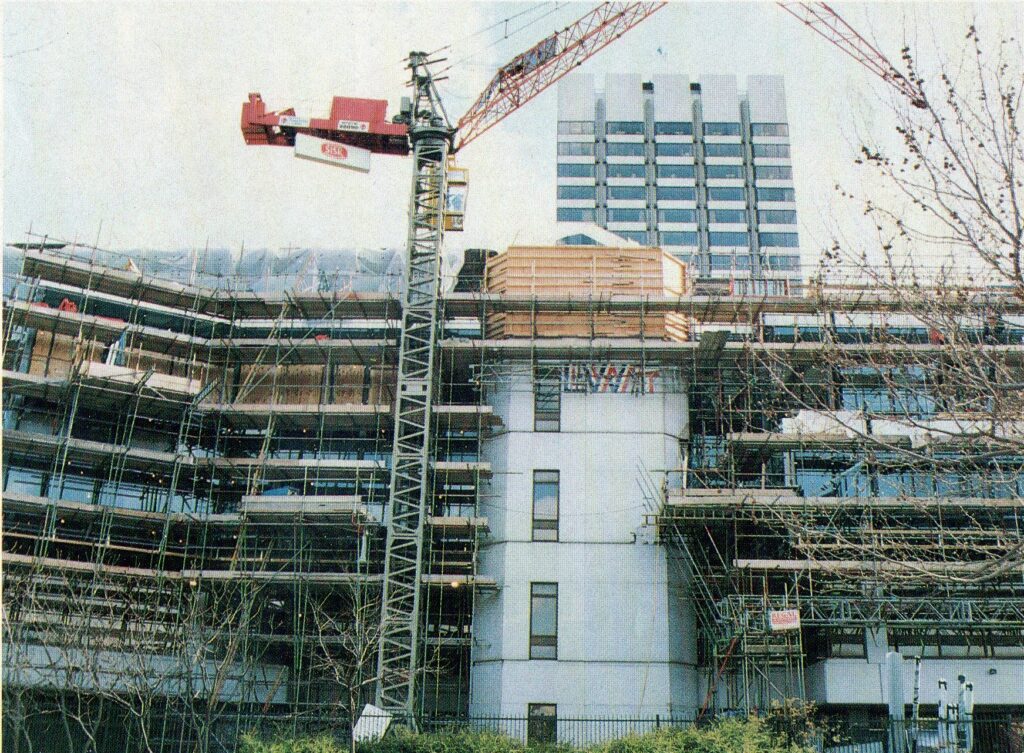
Source: The London Television Centre (A Broadcast sponsored feature) – December 11th 1992
The London Television Centre has undergone a major change of image. Its name, identity, personality and facilities have all been overhauled to ensure it meets its responsibilities as a centre of broadcasting excellence.

Traditionally the building, which sits on the South Bank of the River Thames in London, has been viewed as the home of ITV contractor London Weekend Television (LWT). Building commenced in the late ’60s for that very purpose.
It still is LWT’s home but has now become much more. The latest ITV franchise round has allowed it to forge its own identity. Complete with its change of name (until 1991 it was known as the South Bank Television Centre), it now houses a host of independent television tenants, all of whom have equal rights to original resident LWT.
A series of minor broadcasting revolutions led to this state of affairs. There was the arrival of the new breakfast franchise-holder GMTV following its victory over TV-am. It started moving in at the end of 1991. Then LWT’s long-held ambition of being part of a seven-day-a-week news service for London came to fruition when new London weekday contractor Carlton joined it to create London News Network (LNN). The joint transmission of the two broadcasters and GMTV will also be handled by LNN from The London Television Centre. Most recently ITV’s North-West England contractor Granada merged its overseas programme sales department with LWT’s to add another illustrious name to the centre’s list of occupants.
Before and during these developments The London Television Centre has coped with a re-structuring of LWT which has given greater autonomy to its constituent parts, all of which are now accountable profit centres with their own demands as tenants.

As a consequence, The London Television Centre’s controller Emma Mandley is a very busy woman. She says: “it has led to an enormous cultural change. We have to conside a wider variety of needs. It was straightforward before but now we have a responsibility to all the tenants.”
1992 was dominated by building works as new studios for GMTV and LNN were carved out of nothing. “We had to re-organise some of the tower block for GMTV, build a new control room and refurbish Studio 5,” says Mandley nonchalantly, “but the work we did for LNN was more extensive. We had to rebuild the restaurant and bar so that we could make room for a newsroom and rebuild the transmission centre for a 24-hour operation. There was a hugh amount to be done in a small space of time. The problem was that we didn’t know until October 1991 who had won the franchises and the companies had to be on air by January 1993. Given the scale of what we had to do we’ve done pretty well.”

The customers seem to be happy though. The pyrotechnically-coloured GMTV studio was completed in the autumn and the LNN studio is now complete with a vista over the Thames and St Paul’s which is unmatched by any UK news operation.
There is, of course, more to The London Television Centre than bricks and mortar. Mandley says: “My role is partly to fulfil the functions of a landlord. We have a leasehold on the building and sub-let to the tenants. We manage all the central services used by everyone in the building.”
Those services are fairly far-reaching. Mandley has five managers who co-ordinate functions such as building and design, switchboard and communications, security and reception services, travel and transport, catering and hospitality and vital but easily forgotten functions such as heating, lighting, plumbing, cleaning and the post room. It’s a never ending crusade to keep the tenants happy.
The 18th floor is decked out as hospitality suite with an audio-visual theatre seating 60.
The building has a 23-storey tower block and a squat podium which houses studios. Its scale makes it the dominant feature of the South Bank arts, cultural and media complex that includes, amongst others, the Royal National Theatre, the Royal Festival Hall, the National Film Theatre, the Museum of the Moving Image, IPC Magazines and the Express Newspaper Group.
Being so close to Waterloo Bridge means that it is only a short walk away from Covent Garden on the other side of the river. Its residents are fortunate also that if they have any “important business meetings” to attend to, the locality is replete with restaurants and bars – including the Gabriel’s Wharf complex next door and The London Television Centre’s own facilities, the Riverside Restaurant and Café.

So with the new internal structure, what are Mandley and her team doing to emphasise The London Television Centre’s independence from LWT?
“The first thing is to establish our own corporate identity. We have to reinforce the idea that it’s not just LWT and we have had designers working on that.”
According to Mandley she is tackling both the physical and perception sides of the problem. Signage, for example, is being overhauled, though “in terms of perception it is changing already and will change properly once the new companies are broadcasting and impress their own identities on the place.”
One encouraging piece of dipstick research suggests perceptions are changing. Those redoubtable arbiters of public opinion, taxi drivers, are slowly acknowledging the change: “When you ask for the London Television Centre they now know what you mean,” says Mandley.
So what is Mandley’s vision for The London Television Centre? “I’d like it to be the most important TV centre in Europe. Apart from the BBC we’re pretty well in that role already.”
It is a role that demands tight managerial control. With the TV industry preparing itself for the most competitive phase in its history, The London Television Centre will not be able to use its links with the other companies as a crutch to lean on – something that Mandley recognises. It will need to be as competitive as any other set of facilities.
She stresses that: “Everything I do can be classed as an overhead. And every one of the tenants is looking at reducing overheads. In a way it’s a useful pressure for me because it makes the operation as efficient as possible. All the companies are free to make comparisons.”
She believes that for the tenants The London Television Centre offers huge potential for interaction and useful interchange. The restaurant and bar are used by all and she hopes such facilities will prove attractive to smaller companies looking for office space.
The building has been conceptualised as a TV factory and Mandley says: “We try to attract similar kinds of businesses. It makes sense because that’s what we’re geared up for.”
The evidence suggests there is always room for the non-broadcaster – P&O Bulk Shipping is tucked away at the top of the tower block. Mandley views them as nice tenants who “have had to put up with a lot of disruption in the last year but have been very good about it.
With a new corporate image being put into place, however, and the last skips disappearing off down Upper Ground, it looks like the disruption is nearly over and The London Television Centre’s metamorphosis into Europe’s premier independent television centre is on the road to completion.
Leave a Reply